


Grinding Wheel, Flap Disc or Cut-Off Wheel: Using the Right One (and Never the Wrong Way)
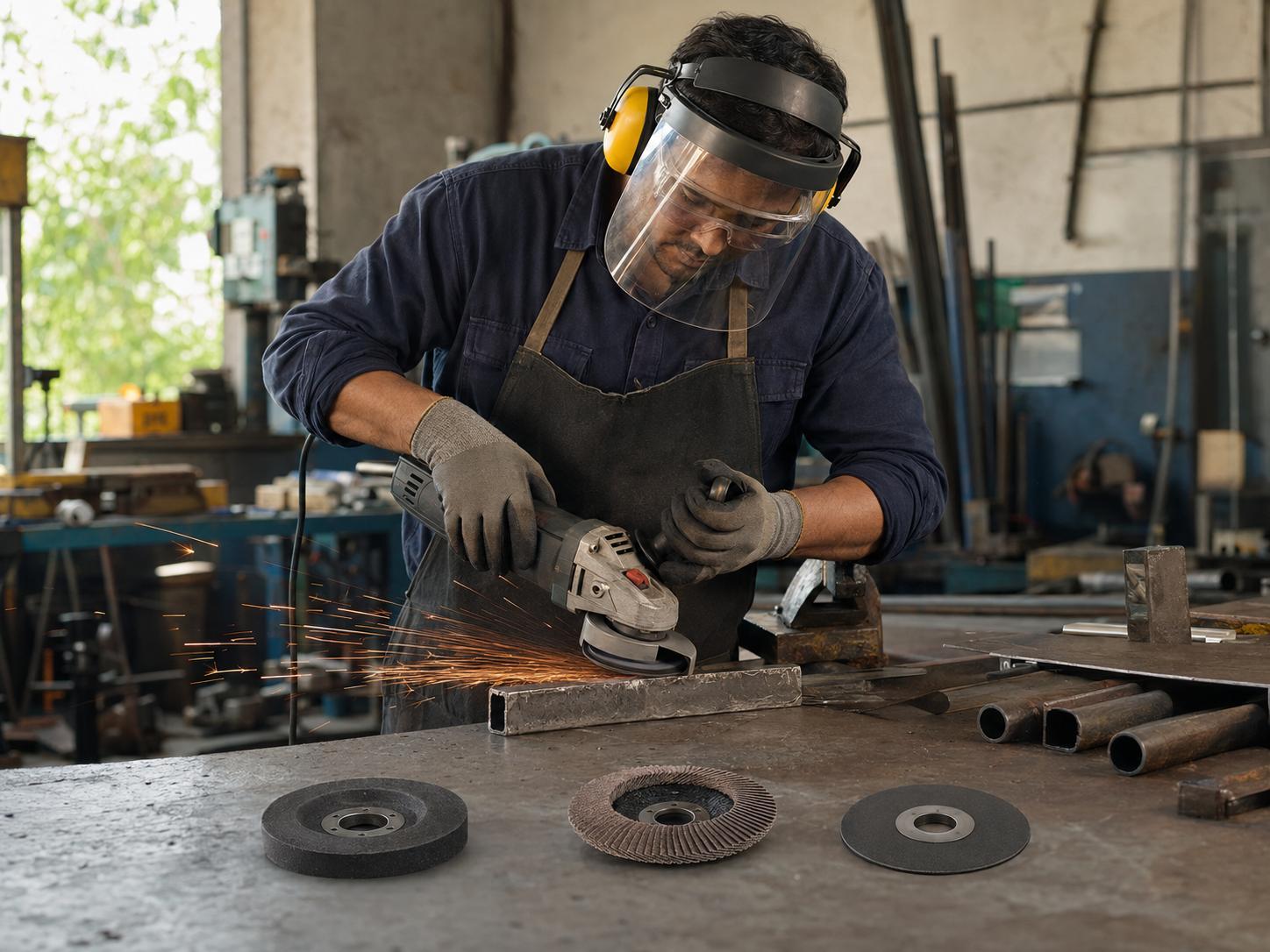
The most dangerous mistake on an angle grinder is not a slip of the hand. It is fitting the wrong disc for the job, and the two versions of that mistake are mirror images: using a thin cut-off wheel to grind, and using a thick grinding wheel to cut. Both put a load on the disc it was never built to take, and both are why discs shatter. On an angle grinder, choosing the right disc and staying safe are not two separate skills. They are the same decision.
We treat this as a safety subject because it is one. A 100 or 115 mm grinder spins near 11,000 rpm, and at that speed the disc has no forgiveness for being asked to do the wrong job. So before any technique, get the disc right.
Three discs, three jobs, no overlap
Each disc on the rack is engineered for one kind of work. The engineering is in the thickness, the bond and the shape, and it does not transfer.
A grinding wheel is thick, usually a depressed-centre disc built to take load on its face. It is for stock removal: grinding down welds, dressing edges, taking metal off a surface. Its body is made to be pressed flat against the work.
A flap disc is layered abrasive flaps on a backing, for blending and finishing. It smooths, deburrs and cleans, sitting between heavy grinding and final polish. It works the surface, not through it.
A cut-off wheel is thin, often 1 to 1.6 mm, and built to take force only on its edge. It is for cutting, and cutting only. Its thinness is the whole point; it slices through metal with a narrow kerf and minimal waste.
The rule that prevents most accidents fits in one line: grind with the grinding wheel, finish with the flap disc, cut with the cut-off wheel, and never cross them. A cut-off wheel used to grind, loaded flat on its face, bends and bursts. A grinding wheel used to cut behaves unpredictably in the kerf. The disc tells you its job by its shape; respect it.
Why the wrong disc is a safety problem, not just a quality one
It would be easier if a wrong disc only gave a bad result. The reason we labour the point is that the failure mode is violent. A thin cut-off wheel takes side load in bending, and abrasive discs are weak in bending. Push one flat against a weld to grind and the bond can crack across the disc, releasing fragments at full speed. The guard and your face shield are what stand between that and an injury.
So matching the disc to the task is the core safety decision, made before the tool is even switched on. Everything that follows, the grip, the guard, the angle, reduces risk further, but none of it saves a cut-off wheel being ground on its face. Selection is where safety starts.
Holding and setting up the grinder
With the right disc fitted, technique keeps you safe. These are the habits that matter, and they are not optional extras.
1. Two hands, always, with the side handle fitted. One hand on the body, one on the auxiliary handle, gives you the control to hold the tool if it grabs. A grinder is not a one-handed tool.
2. Guard on and positioned between the disc and you. The guard redirects sparks and, in a failure, fragments. Removing it to reach an awkward spot removes your main protection. Reposition the guard instead of taking it off.
3. Mount the disc snug, not overtight. The flange nut should be firm enough to hold the disc without slipping, but cranking it down excessively can stress the disc. Follow the tool's instructions for fitting.
4. Check the disc before fitting. No cracks, no chips, within its expiry date. Resinoid bonds degrade with age, so an old disc can fail even unused. A dropped disc may hide an internal crack; retire it.
None of this is new, and all of it is skipped somewhere every day. The operators who keep their fingers are the ones who do it every time, not most times.
Mount it the way the tool intends
A detail that gets skipped: the flanges that clamp the disc are part of the safety system, not loose washers. Use the flanges supplied with the grinder, seated the right way round, and never fit a disc without the backing flange or with a damaged one. The flange spreads the clamping load evenly across the disc; a missing or wrong flange concentrates stress and invites a crack.
Use the spindle lock only when the tool is fully stopped, never to slow a spinning disc, and tighten the nut by hand with the supplied spanner rather than forcing it. A disc mounted crooked because the flange was dirty or a burr sat under it will run out of true and vibrate, which you will feel through the handle. If a newly fitted disc vibrates, stop and check the mounting before you cut; the wobble is telling you something is not seated right.
Technique that prevents kickback
Kickback, the grinder jumping back or across at you, comes from the disc grabbing. It is prevented more by technique than by strength.
For grinding, hold the wheel at roughly a 15 to 30 degree angle to the surface. Too flat and it skates and loads; too steep and it digs and grabs. Within that window the wheel cuts steadily and predictably. Let the wheel's speed do the work rather than forcing it; leaning hard does not remove metal faster, it just heats everything and raises the grab risk.
For cutting, keep the cut straight and let the wheel track its own line without twisting, which pinches and binds it. Support the workpiece so the cut opens rather than closes on the disc. A binding wheel is the classic kickback and shatter trigger, and it is almost always caused by an unsupported cut closing on the blade.
Respect the disc's maximum rpm, which must meet or exceed the grinder's speed, and respect the expiry date. Both are printed on the disc for a reason.
PPE and the first few seconds of a cut
The gear you wear and how you start the tool decide a lot of the risk, and both are cheap to get right.
A grinder throws sparks, hot metal and, in a failure, fragments, so a full face shield beats safety glasses alone; glasses protect the eyes but leave the rest of the face exposed. Add gloves, ear protection against the shriek, and, when cutting or grinding materials that make hazardous dust such as concrete or stone, a proper dust mask. Loose sleeves, dangling cords and jewellery stay away from the disc, because a spinning wheel grabs anything that drifts into it.
The first few seconds of every cut are the most dangerous, so treat them deliberately. After fitting a new disc, many operators run the grinder briefly at no load, standing aside, to confirm the disc is sound before bringing it to the work. Let the disc reach full speed before it touches the metal, and start the cut or grind gently rather than stabbing into it. Ease in, let it settle into the material, then work at a steady pace. A disc slammed into the work at part speed, or forced from a standstill, is far more likely to grab and kick.
None of this is expensive or slow. It is the difference between a routine job and an incident report, and the operators who never get hurt are simply the ones who do it every single time.
The pushback we will offer
Here is a nuance that runs slightly against the tidy "one disc, one job" line, and we would rather you hear it than learn it the hard way. People see combined or multi-purpose discs advertised and assume the rule has relaxed. It has not. Specialist discs exist, but the default discipline stands: a cut-off wheel is not a grinding wheel because you are in a hurry, and no marketing changes the physics of a thin disc under side load. If a job seems to need a disc doing two jobs, the safer answer is usually to change discs, not to push one past its design.
We will also admit an honest limit. We cannot see your specific tool, disc or workpiece, and conditions vary, so nothing here replaces the manufacturer's instructions for your exact equipment or your workplace's safety rules. When the printed guidance and a habit disagree, follow the printed guidance.
Grinding safely: getting it right every time
The whole of angle grinder safety compresses into a short sequence. Pick the disc for the task, grinding wheel to grind, flap disc to finish, cut-off wheel to cut. Inspect it, fit it correctly, keep the guard on, hold the tool with two hands, work at the right angle, support the work, and let the disc do the cutting. Match the rpm and mind the expiry.
For stocking the right disc for each job, Yuri Tools, based in Mumbai, supplies grinding wheels, flap discs and cutting wheels, along with the angle grinders that run them, across the value YURI Tools and premium DAYURI Tools ranges. Having the correct disc on hand is what makes "use the right one" a habit rather than a compromise, because the wrong-disc mistake usually happens when the right disc simply is not in the box.
Safety note: always wear eye and face protection and follow the disc and tool manufacturer's instructions and your site safety rules. This article is general guidance, not a substitute for proper training on the specific equipment you use.

 English
 French
 Spanish
 Portuguese
 Deutsch
 Turkish
 Dutch
Dutch
 Italiano
 Russian
 Romaian
 Portuguese (Brazil)
 Greek
Greek