


The Long Island: Why Dhigurah Deserves Your Next Maldives Dive Trip
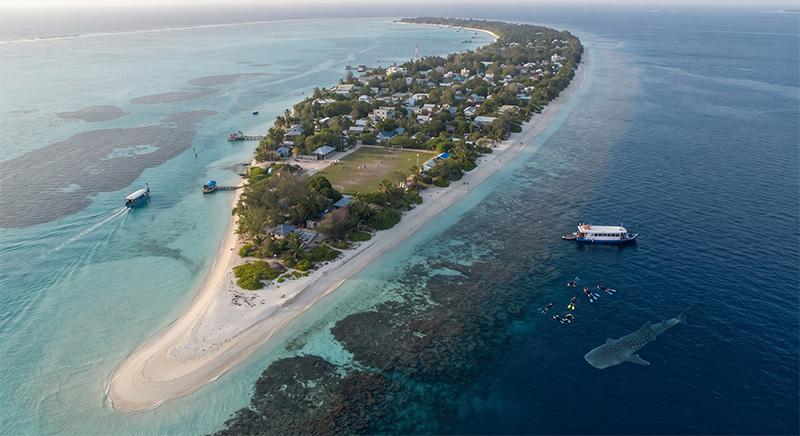
The boat slows over the outer reef, the captain reads the surface for a shark several metres long, and for a few minutes the biggest fish in the sea moves along beside a handful of snorkellers who will talk about it for the rest of their lives. That stretch of water sits off Dhigurah, a long, thin sliver of an island near the southern end of South Ari Atoll. It's not a private resort island with a single jetty and a locked gate. It's a working village of around 630 people, with two schools, a doctor, and a three-kilometre beach that ends in a sandbank the locals call Thundi.
We run Boutique Beach, a small dive hotel on that island, and we've dived these reefs every day for ten years. What follows isn't a brochure. It's the honest case for why a local island, and this one in particular, belongs at the top of a diver's Maldives list.
A working island, not a resort island
For most of the country's life as a holiday destination, the Maldives offered visitors exactly one kind of place to stay: a resort built on its own uninhabited island, one property to a patch of sand, with prices to match. That changed in 2012, when the government first allowed guesthouses to open on inhabited local islands. It was a quiet piece of policy with a large effect. It put the real Maldives, the one where people live and work and pray and fish, within reach of ordinary travellers for the first time.
Dhigurah is one of the islands that grew up in that shift. Because it's a local island, a few things are true that surprise first-time visitors. No alcohol is served on Dhigurah, out of respect for the island's faith; guests who want a drink take a ten-minute boat ride to a nearby resort. Dress in the village is relaxed but modest.
In exchange, you get something no resort island can sell you: a place with a life of its own. The name Dhigurah means "long island" in Dhivehi, the Maldivian language, and the beach that runs down its spine is one of the longest in the country. You can walk it in the evening past fishermen, footballers, and kids on bikes, and none of it is staged for you.
The reef is the reason
Dhigurah sits inside the South Ari Marine Protected Area, forty-two square kilometres of reef and channel that make up the largest protected area in the Maldives. This is the part that matters to a diver. The water here holds whale sharks all year, not just for a single season.
The numbers behind that aren't ours; they belong to the researchers who work these waters. More than 726 individual whale sharks have been logged inside the protected area across more than 8,000 recorded encounters, and because nearly three-quarters of them are young males that vanish from the record once they pass about eight metres, the scientists who count them have come to see South Ari not as a place the animals pass through but as a nursery they use and then outgrow, quite possibly the single most reliable place in the world to meet the same whale shark twice.
The whale sharks themselves live along the outer reef, known in Dhivehi as the Beyru, not in the channel. The channel is where the diving pinnacles are: fifteen deep reefs, or thilas, standing up from the sea floor a short boat ride from the harbour. Kudarah Thila, protected since 1995, throws thousands of blue-stripe snappers into the current for the tunas and sharks to hunt. Broken Rock has a canyon narrow enough that divers pass through it one at a time. Five Rocks, the Kudima Wreck, Manta Point: there are more than fifty dive sites within reach of a single hotel.
How the diving actually runs
We're a PADI 5 Star centre with six instructors, and we keep the groups small, no more than four or five divers to a guide. Most days there are up to three dives on offer, and the boat is our own. We built it on Dhigurah, for exactly the way divers actually use a boat: freshwater showers, a proper toilet, a dedicated tub for camera gear. Our captain, Ibrahim, has been reading these currents and spotting whale sharks along the Beyru for more than thirty years, and he and the other captains still find the fifteen thilas by the shape of the water rather than by GPS.
Back on land, the day doesn't just end. A marine biologist gives a presentation, and the team edits the day's underwater footage and posts it the same evening, so guests can watch the reef they dived and send it home to family. Over a week you see the whole range of the place, from the largest fish in the ocean to a nudibranch the size of a fingernail.
One rate, and no surprises
At most Maldives dive resorts, the headline room rate is the start of the arithmetic, not the end. Diving is charged by the dive, often 65 to 120 US dollars at the luxury properties. Equipment hire adds twenty to forty dollars a dive. A service charge of ten to sixteen per cent lands on top, and a green tax of twelve dollars per person per night sits alongside it. A week of diving can cost far more than the room ever suggested.
We run the other way. Our all-inclusive dive package folds your two or three daily dives, the guide, the boat, your tanks and weights, and every meal and soft drink into one number, with the service charge and GST already inside it. Equipment hire, Nitrox fills, PADI courses, and the airport transfer sit outside it, and we say so plainly, because the whole point is that the figure you agree to is the figure you pay. We've long described it ourselves as a liveaboard on land, and we've never found a better way to put it.
The people who keep coming back
The clearest proof this works is the guests who return. A couple named Otto and Ingrid hold our record at nine stays. Ingrid, who is German, spends part of her visits hand-knitting little wool scuba divers and whale sharks, which she sells to raise money for the Dhigurah health centre; she's passed 1,500 US dollars so far. That's the kind of thing that happens on an island where the hotel, the divers, and the 630 people who live there share the same three kilometres of sand.
A resort island sells you privacy. A local island gives you a place. Dhigurah has year-round whale shark water on one side and a working village on the other, and for a diver that isn't a compromise between the two. It's the reason to come.

 English
 Arabic
 French
 Portuguese
 Deutsch
 Turkish
 Dutch
Dutch
 Italiano
 Russian
 Romaian
 Portuguese (Brazil)
 Greek
Greek