


Healthcare Software Development Company | Custom Solutions
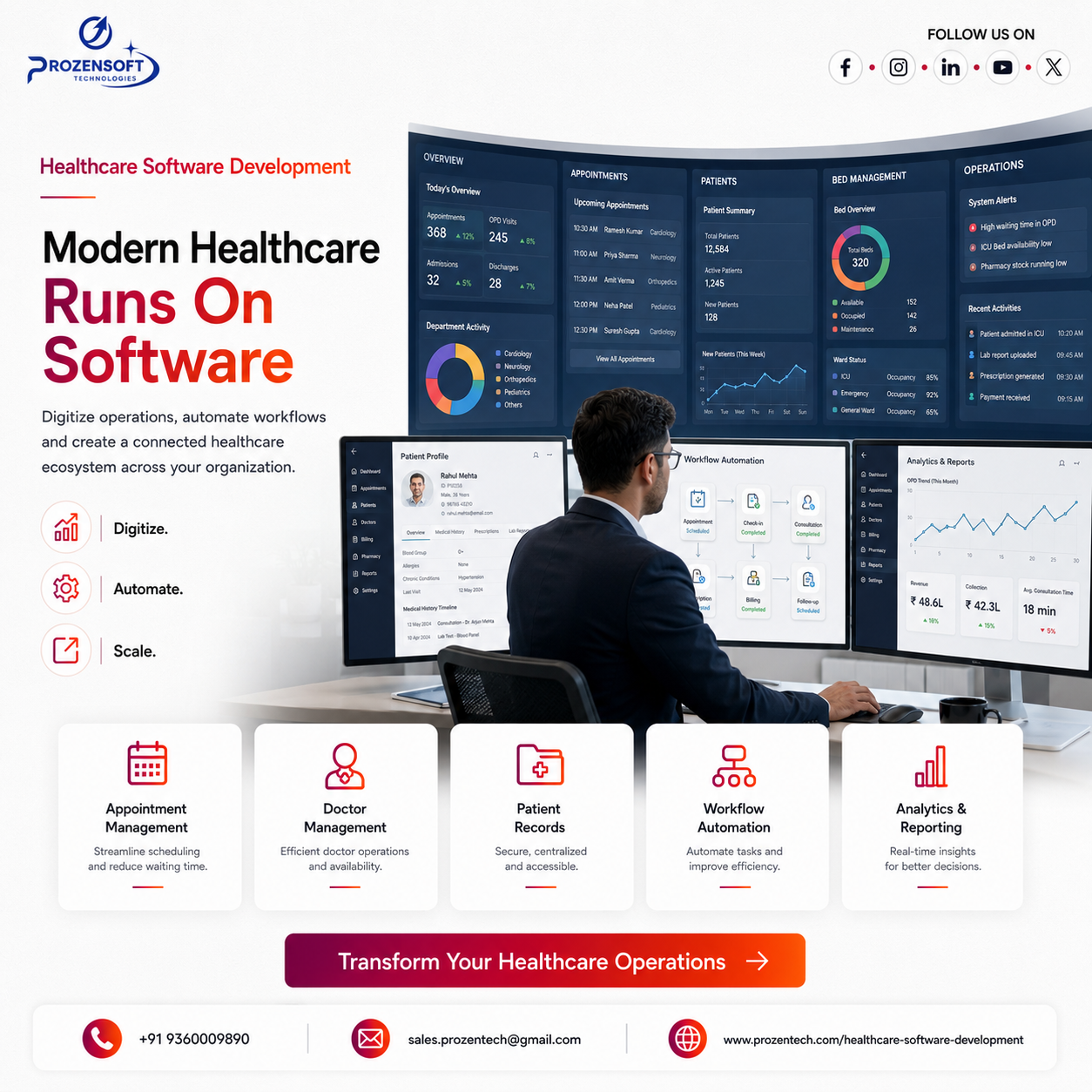
Healthcare organizations manage some of the most complex operations in any industry.
Hospitals and clinics must coordinate patients, doctors, appointment schedules, consultations, branches, payments, documents, staff access, follow-ups, and administrative tasks every day. When these activities are handled through disconnected tools, spreadsheets, paper records, phone calls, and outdated systems, even routine work can become slow and difficult.
Professional healthcare software development helps bring these processes into one connected digital environment.
A custom healthcare system can improve patient access, reduce repetitive administrative work, support healthcare professionals, and give management teams better visibility across the organization.
However, healthcare software should never be treated as a generic business application. It must be designed around actual healthcare workflows, strong access controls, data security, regional requirements, and long-term scalability.
What Is Healthcare Software Development?
Healthcare software development is the process of designing and building digital systems for hospitals, clinics, doctors, patients, healthcare networks, diagnostic centres, telemedicine companies, and other medical service providers.
Depending on the organization, the software can support:
- Patient registration
- Doctor management
- Appointment scheduling
- Hospital and clinic branches
- Video consultations
- Consultation records
- Digital prescriptions
- Medical document management
- Billing and payments
- Refund management
- Staff permissions
- Notifications
- Reports and analytics
- Multi-language support
- Multi-location healthcare operations
The system can include mobile applications, web portals, administrative dashboards, internal staff tools, and backend services.
Why Healthcare Organizations Need Custom Software
Many healthcare organizations already use digital tools, but those systems may not communicate with each other.
For example, appointments may be stored in one system, payments in another, patient documents in a third, and doctor schedules in spreadsheets.
This creates several operational problems:
- Duplicate patient information
- Appointment conflicts
- Slow access to records
- Manual data entry
- Delayed communication
- Billing confusion
- Limited branch visibility
- Difficult reporting
- Poor patient experience
- Increased administrative workload
Custom healthcare software can connect the most important workflows while adapting to the way the organization actually operates.
It can help create one reliable source of information for patients, doctors, staff, and management teams.
Healthcare Software Is More Than Appointment Booking
Appointment booking is an important feature, but healthcare software can support the complete patient and operational journey.
A connected healthcare platform can manage:
- Patient registration
- Doctor discovery
- Hospital or clinic selection
- Appointment booking
- Payment
- Appointment confirmation
- Patient arrival or online consultation
- Doctor consultation
- Medical notes
- Prescription creation
- Follow-up scheduling
- Refunds or billing adjustments
- Patient history
- Operational reporting
The goal is to reduce disconnected processes and create a clearer workflow from beginning to end.
Types of Healthcare Software Solutions
Different healthcare businesses need different systems.
Hospital Management Software
Hospital software can help manage doctors, departments, branches, appointments, patients, payments, staff users, and daily administrative activities.
Clinic Management Software
Clinic software can provide a more focused solution for appointment scheduling, doctor availability, consultation records, billing, and patient communication.
Telemedicine Software
Telemedicine platforms allow patients and doctors to connect through scheduled or on-demand video consultations.
Doctor Practice Management Software
Independent doctors and specialist groups can manage schedules, patients, consultations, follow-ups, payments, and multiple clinic locations.
Patient Management Software
Patient-focused systems can manage registration, profiles, appointments, documents, medical history, communication, and service access.
Healthcare Marketplace Software
A marketplace platform can connect patients with multiple hospitals, clinics, doctors, and specialists.
Diagnostic Centre Software
Diagnostic businesses may require test bookings, branch management, patient reports, payments, home sample collection, and notification systems.
Wellness and Therapy Software
Healthcare technology can also support physiotherapy, nutrition, counselling, rehabilitation, alternative care, and wellness service providers.
The software structure should always reflect the specific healthcare model.
Patient Registration and Profile Management
Patient registration is often the first interaction with the platform.
The software can support:
- Mobile number registration
- Email registration
- OTP verification
- Password authentication
- Patient identification number
- Personal details
- Emergency contact
- Address
- Preferred language
- Uploaded medical documents
- Appointment history
The registration process should remain simple while collecting only the information required for the service.
Patient profiles can reduce repeated form filling during future appointments.
Doctor and Healthcare Professional Management
Healthcare organizations need a structured way to manage doctors and other professionals.
The system can maintain:
- Doctor name
- Profile photograph
- Medical specialty
- Qualifications
- Registration number
- Licence details
- Experience
- Languages spoken
- Hospital affiliations
- Clinic branches
- Consultation modes
- Consultation fees
- Available schedules
- Verification status
Administrators can review professional documents before making the doctor available for patient bookings.
Specialty and Department Management
Healthcare software can organize medical professionals and services into departments such as:
- General medicine
- Cardiology
- Dermatology
- Orthopaedics
- Paediatrics
- Gynaecology
- Neurology
- Psychiatry
- Dentistry
- Ophthalmology
- ENT
- Physiotherapy
- Diabetology
- Oncology
- Nutrition
Hospitals can also create custom specialties and departments based on their services.
Clear organization helps patients find the right doctor more quickly.
Appointment Scheduling Software
Appointment scheduling is one of the most important components of a healthcare system.
The platform can support:
- Doctor-specific availability
- Branch-specific schedules
- Fifteen-minute slots
- Thirty-minute slots
- Custom appointment duration
- Break times
- Holidays
- Doctor leave
- Blocked dates
- Online consultations
- In-person consultations
- Follow-up appointments
- Walk-in appointments
- Rescheduling
- Cancellations
Once a patient books a slot, the system should prevent another patient from selecting the same time.
Multi-Hospital and Multi-Branch Management
Healthcare groups often operate across several clinics, hospitals, or branches.
A scalable platform can support:
- Multiple hospitals
- Multiple clinics
- Branch-specific doctors
- Different services by branch
- Branch-specific consultation fees
- Different operating hours
- Local staff accounts
- Branch appointment calendars
- Separate payment records
- Centralized reports
A doctor can also have different schedules and fees at different locations.
For example, the same specialist may consult at one hospital in the morning and another clinic in the evening.
Patient Appointment Journey
A typical patient booking flow may include:
- The patient selects a city or branch.
- A specialty or doctor is chosen.
- The patient reviews the doctor profile.
- The consultation type is selected.
- Available dates and time slots are displayed.
- Patient details are confirmed.
- Payment is completed if required.
- The appointment is confirmed.
- Automated reminders are sent.
- The consultation is completed.
- Follow-up instructions are provided.
A clear patient journey can reduce confusion and improve appointment completion rates.
Telemedicine Software Development
Telemedicine can improve access to doctors for patients who cannot easily travel to a healthcare facility.
A telemedicine system can include:
- Appointment-based meeting creation
- Secure doctor and patient access
- Waiting room
- Video and audio controls
- Consultation status
- Doctor notes
- Patient document access
- Digital prescription
- Follow-up scheduling
- Payment integration
- Consultation history
Video consultation access should be available only to authorized users linked to the correct appointment.
The technical workflow should also consider connection failures, missed consultations, rescheduling, and refund policies.
Digital Prescription Management
Healthcare software can allow doctors to create and share digital prescriptions.
A prescription may contain:
- Patient details
- Doctor details
- Consultation date
- Medicine names
- Dosage
- Frequency
- Duration
- Instructions
- Recommended tests
- Follow-up date
- Additional medical advice
Patients can securely access the prescription through their account.
Prescription workflows should be implemented according to the laws and medical regulations of the target market.
Patient Document Management
Patients may need to upload documents before or after a consultation.
Supported documents can include:
- Laboratory reports
- Scan results
- Previous prescriptions
- Referral letters
- Medical summaries
- Insurance documents
- Identification documents
- Discharge records
The system should provide secure storage and controlled access.
Only authorized professionals and staff should be able to view relevant patient documents.
Consultation Notes and Medical Records
Doctors may need to record information during or after an appointment.
The platform can support:
- Symptoms
- Medical observations
- Diagnosis
- Treatment plans
- Recommended tests
- Follow-up advice
- Patient-visible notes
- Private clinical notes
Different note types can be protected through role-based permissions.
Healthcare software should also maintain a clear record of who created or updated important information.
Billing and Payment Management
Healthcare organizations may collect payments for:
- Doctor appointments
- Video consultations
- Follow-up consultations
- Diagnostic services
- Healthcare packages
- Premium appointments
- Other medical services
The platform can support:
- Credit card payments
- Debit card payments
- Digital wallets
- Online banking
- Cash at clinic
- Regional payment gateways
- Insurance-linked payment workflows
- Partial payments
- Payment receipts
Payment records can be connected directly to patients, appointments, hospitals, and doctors.
Refund and Cancellation Management
Healthcare appointments may be cancelled by patients, doctors, or healthcare organizations.
Refund rules may depend on:
- Cancellation time
- Doctor availability
- Consultation type
- Payment method
- Technical failure
- Duplicate payment
- Hospital policy
- No-show status
The platform can support full or partial refunds and maintain a clear transaction record.
Patients should receive status updates when a refund is initiated or completed.
Staff and Role-Based Access Management
Healthcare platforms serve different types of users.
These can include:
- Patients
- Doctors
- Nurses
- Receptionists
- Hospital managers
- Clinic administrators
- Branch managers
- Finance teams
- Support staff
- Platform administrators
Each role should receive only the permissions required to complete its work.
For example:
- A receptionist may manage appointments.
- A doctor may access patient information related to consultations.
- A finance user may manage payments and refunds.
- A branch manager may view branch-level operations.
- A system administrator may manage platform settings.
Role-based access helps reduce unauthorized exposure of sensitive information.
Notification and Reminder Management
Automated communication can reduce missed appointments and repeated support calls.
The platform can send notifications for:
- Appointment confirmation
- Appointment reminder
- Doctor cancellation
- Appointment rescheduling
- Payment confirmation
- Refund update
- Video consultation access
- New prescription
- Follow-up reminder
- Medical document update
Notifications can be delivered through:
- Push notifications
- SMS
- In-app messages
The organization should be able to configure which notifications are sent and when.
Hospital and Clinic Administrative Dashboard
The administrative dashboard can provide centralized control over the healthcare operation.
Administrators may manage:
- Patients
- Doctors
- Medical specialties
- Hospitals
- Clinics
- Branches
- Doctor verification
- Appointment slots
- Consultations
- Payments
- Refunds
- Notifications
- Staff accounts
- Permissions
- Reports
- Platform settings
The dashboard should help teams identify pending actions quickly.
Operational Reports and Analytics
Healthcare management teams need accurate information for decision-making.
The platform can provide reports on:
- Total patients
- New patient registrations
- Upcoming appointments
- Completed consultations
- Cancelled appointments
- No-show rates
- Online consultations
- In-person consultations
- Doctor availability
- Branch performance
- Popular specialties
- Revenue
- Refunds
- Payment methods
- Appointment volumes
- Follow-up rates
Reports should support operational improvement while respecting patient privacy.
Healthcare Software Integrations
Custom healthcare software may need to connect with existing internal and external systems.
Possible integrations can include:
- Payment gateways
- Video consultation tools
- SMS providers
- Email services
- Push notifications
- Laboratory systems
- Pharmacy systems
- Insurance platforms
- Accounting software
- Customer support tools
- Analytics platforms
- External healthcare databases
- Electronic health record systems
Integration requirements should be identified during the planning stage.
APIs should be designed securely and documented clearly.
Healthcare Data Security
Healthcare software may process personal data, medical records, payment details, prescriptions, and private communications.
Security should be considered from the beginning of development.
Important measures can include:
- Encrypted network communication
- Secure password storage
- Multi-factor authentication
- OTP verification
- Role-based permissions
- Secure file storage
- Data backups
- Session management
- Audit logs
- Activity monitoring
- Access revocation
- Security testing
- Incident response procedures
- Secure cloud configuration
Security is not a one-time activity. It requires continuous monitoring and maintenance after launch.
Healthcare Compliance Considerations
Healthcare and privacy regulations vary between countries.
Depending on the target market, healthcare organizations may need to consider:
- Patient consent
- Medical record retention
- Data storage location
- Patient access rights
- Data-sharing restrictions
- Telemedicine regulations
- Prescription regulations
- Healthcare licensing
- Privacy documentation
- Breach notification procedures
Software development teams can implement technical controls, but healthcare businesses should also obtain professional legal and compliance guidance for every target country.
Healthcare Software Development for the United States
Healthcare software targeting the United States may need to consider:
- Strong health data safeguards
- Secure patient communication
- Telehealth workflows
- Multi-state provider availability
- Appointment documentation
- Insurance-related processes
- Access controls
- Audit records
- Billing integrations
The final system requirements depend on the type of healthcare organization and data being processed.
Healthcare Software Development for Canada
Canadian healthcare platforms may need to support:
- Provincial healthcare differences
- Virtual consultation workflows
- Referral processes
- Secure patient communication
- Bilingual interfaces where required
- Clinic scheduling
- Regional billing requirements
The platform should be flexible enough to support different operational models across provinces.
Healthcare Software Development for the UK and Europe
Healthcare software for the United Kingdom and European markets may require:
- Strong privacy controls
- Patient consent management
- Multi-language support
- Regional healthcare workflows
- Local payment providers
- Country-specific telemedicine rules
- Secure data access
- Digital appointment records
The platform should also allow regional configurations where healthcare processes differ.
Healthcare Software Development for the UAE and Middle East
Healthcare organizations in the UAE, Saudi Arabia, Qatar, and other Middle Eastern markets may require:
- Arabic and English interfaces
- Right-to-left support
- Multi-hospital management
- Branch-specific doctor schedules
- Private healthcare booking
- Premium video consultations
- Regional payment gateways
- Specialist discovery
- Multi-currency support
The system should deliver a professional experience across mobile and web platforms.
Healthcare Software Development for India and Southeast Asia
Healthcare software in India and Southeast Asia may focus on:
- Affordable appointment booking
- Multi-clinic networks
- Video consultations
- Mobile-first patient access
- Regional languages
- Cash and online payments
- Digital prescriptions
- Follow-up appointments
- Branch-based doctor availability
- Flexible appointment durations
The platform should remain responsive across different mobile devices and network conditions.
Healthcare Software for Other Global Markets
In Australia, Africa, and Latin America, healthcare systems may need to support:
- Remote consultations
- Regional languages
- Local payment providers
- Limited connectivity
- Doctor shortages
- Multi-location healthcare networks
- Flexible clinic workflows
- Mobile-first healthcare access
GEO-friendly healthcare software development should consider how patients access care in each target market instead of using one identical configuration worldwide.
Different Healthcare Software Business Models
Healthcare software can support several commercial and operational models.
Software for a Single Hospital
The system is developed specifically for one hospital and its internal workflows.
Multi-Hospital Platform
Several hospitals and clinics operate through a shared digital ecosystem.
Software-as-a-Service Model
Healthcare organizations pay monthly or annual fees to use the platform.
Healthcare Marketplace Model
Doctors, clinics, and hospitals join the platform while patients search and book services.
Telemedicine Marketplace
Patients connect with available doctors for online consultations.
White-Label Healthcare Software
The platform is customized and launched under the healthcare organization’s own brand.
Corporate Healthcare Platform
Companies provide healthcare access, consultations, and wellness services to employees.
The architecture and payment model should reflect the chosen business strategy.
How Healthcare Software Can Generate Revenue
A healthcare software platform can support revenue through:
- Software subscription fees
- Hospital licensing fees
- Clinic subscription plans
- Doctor subscription plans
- Appointment commissions
- Teleconsultation charges
- Platform service fees
- Patient membership plans
- Corporate healthcare contracts
- White-label licensing
- Custom integration charges
- Maintenance and support plans
The revenue structure should be transparent to all participating healthcare providers.
Technology Stack for Healthcare Software Development
The technology stack should support security, performance, real-time communication, video consultations, integrations, and future scalability.
A modern architecture may include:
- React Native for patient and doctor mobile applications
- Next.js for hospital portals and administrative dashboards
- Node.js and Express.js for backend services and APIs
- MongoDB for patients, doctors, hospitals, appointments, and transaction data
- Redis for caching, session management, and schedule performance
- Socket.IO for real-time appointment and consultation updates
- Jitsi or another video platform for telemedicine
- Stripe or regional payment gateways for payments and refunds
- Push notification services for alerts and reminders
- Cloud infrastructure for secure hosting, scaling, storage, backups, and monitoring
The final technology choices should depend on expected user volume, data requirements, integrations, target countries, and healthcare workflows.
Healthcare Software Development Process
A structured development process helps reduce operational and technical risks.
Step 1: Requirement Discovery
The team studies:
- Healthcare business model
- Patient journey
- Doctor workflow
- Hospital structure
- Existing systems
- Payment process
- Security requirements
- Target countries
- Required integrations
Step 2: Workflow Documentation
Patient, doctor, staff, administrator, billing, and consultation workflows are clearly documented.
Step 3: System Architecture Planning
The platform structure, database, integrations, permissions, security controls, and scalability requirements are planned.
Step 4: UI and UX Design
Patient interfaces should be easy to understand.
Doctor and staff interfaces should reduce unnecessary actions and make important information quickly accessible.
Step 5: Backend Development
The backend manages users, hospitals, doctors, schedules, appointments, payments, files, permissions, and notifications.
Step 6: Mobile and Web Application Development
Patient apps, doctor apps, hospital portals, staff interfaces, and admin dashboards are developed and connected to backend APIs.
Step 7: Integration Development
Payments, video consultation, notifications, laboratories, insurance systems, and other services are connected where required.
Step 8: Testing
Testing should include:
- Patient registration
- Doctor registration
- Document verification
- Appointment scheduling
- Duplicate slot prevention
- Multi-branch schedules
- Payment failure
- Refund processing
- Video consultation access
- Prescription creation
- File permissions
- Unauthorized access
- Role restrictions
- System performance
- Backup restoration
Step 9: Deployment
The platform is deployed to secure infrastructure with monitoring, backups, and access controls.
Step 10: Maintenance and Improvement
After launch, the system requires:
- Security updates
- Performance monitoring
- Error tracking
- User support
- Backup checks
- Workflow improvements
- Integration maintenance
- Feature updates
Healthcare software should evolve along with the organization.
Why Scalability Matters in Healthcare Software
A healthcare platform may begin with one clinic and a few doctors.
Later, the organization may add:
- More patients
- Additional doctors
- New specialties
- Multiple clinics
- Hospital branches
- Video consultations
- Diagnostic services
- Corporate healthcare
- Additional countries
- Multiple languages
- New payment systems
- External integrations
A scalable architecture can support this growth without requiring the entire platform to be rebuilt.
Why Choose Custom Healthcare Software Development?
Generic healthcare tools may provide standard features, but they may not match the organization’s real processes.
Custom software provides greater control over:
- Patient registration
- Doctor onboarding
- Appointment rules
- Consultation duration
- Branch management
- Payments
- Refunds
- Telemedicine
- Medical documents
- Prescriptions
- Staff permissions
- Notifications
- Integrations
- Reports
- Branding
- Future expansion
The software can adapt to the healthcare organization instead of forcing teams to change their entire operation around a rigid system.
How Prozentech Helps Build Healthcare Software
At Prozentech, we develop custom healthcare software for hospitals, clinics, doctor networks, telemedicine startups, healthcare marketplaces, and medical service businesses.
Our healthcare software solution can include:
- Patient mobile application
- Doctor mobile application
- Hospital and clinic portal
- Admin management dashboard
- Patient profile management
- Doctor registration and verification
- Medical specialty management
- Multi-hospital support
- Multi-branch support
- Branch-specific doctor schedules
- Branch-specific consultation fees
- Fifteen-minute appointment slots
- In-person appointment booking
- Video consultations
- Patient document management
- Digital prescriptions
- Payment integration
- Refund management
- Staff roles and permissions
- Appointment notifications
- Multi-language support
- Reports and analytics
The complete system can be customized around the organization’s name, branding, healthcare services, branches, doctors, scheduling rules, payment workflow, and target market.
Healthcare businesses can begin with a focused system and expand the same platform as their patients, doctors, locations, services, and integrations grow.
Frequently Asked Questions About Healthcare Software Development
What is healthcare software development?
Healthcare software development is the process of building custom digital systems for managing patients, doctors, hospitals, clinics, appointments, consultations, payments, documents, and healthcare operations.
What types of healthcare software can be developed?
Businesses can build hospital management systems, clinic software, telemedicine platforms, doctor practice software, patient portals, healthcare marketplaces, and custom medical applications.
Can the software support multiple hospitals?
Yes. The platform can manage multiple hospitals, clinics, departments, branches, doctors, schedules, payments, and staff accounts.
Can doctors have different schedules at different branches?
Yes. Each doctor can have separate working hours, appointment slots, consultation fees, and services for every hospital or clinic location.
Can patients book appointments online?
Yes. Patients can search for doctors, choose a specialty, select a branch, view available slots, and confirm appointments.
Can the software support video consultations?
Yes. Telemedicine can be integrated for online appointments, follow-ups, and remote consultations.
Can the platform support fifteen-minute appointment slots?
Yes. Appointment duration can be configured as fifteen minutes, thirty minutes, or another custom interval.
Can patients upload medical documents?
Yes. Patients can upload reports, scans, prescriptions, referral letters, and other relevant documents through secure access.
Can doctors create digital prescriptions?
Yes. Doctors can create prescriptions containing medicines, dosage, duration, instructions, tests, and follow-up information, subject to local regulations.
Can online payments be integrated?
Yes. Stripe or suitable regional payment providers can be integrated for appointments and healthcare services.
Can refunds be managed through the platform?
Yes. Full and partial refunds can be handled according to cancellation, payment, and healthcare organization policies.
Does the software support staff permissions?
Yes. Role-based access can be configured for doctors, receptionists, managers, finance teams, support staff, and administrators.
Can healthcare software integrate with existing systems?
Yes. Custom APIs and integrations can connect the platform with laboratories, pharmacies, accounting tools, insurance systems, and other healthcare software where supported.
Can the system support multiple languages and currencies?
Yes. The platform can support multiple languages, currencies, date formats, time zones, and regional payment gateways.
Is healthcare software secure?
The platform can include encryption, secure authentication, access controls, audit logs, protected file storage, backups, monitoring, and security testing. Legal and compliance requirements should also be evaluated for every target country.
Can the software be launched under my healthcare brand?
Yes. Mobile apps, portals, dashboards, domain, colours, logo, and workflows can be customized around the healthcare organization’s identity.
Final Thoughts
Digital healthcare software should make complex healthcare operations easier without compromising security, patient trust, or professional workflows.
A well-developed system can connect patients, doctors, hospitals, clinics, appointments, consultations, payments, documents, and administrative teams through one scalable platform.
For patients, it provides easier access to healthcare services. For doctors, it creates a clearer schedule and consultation workflow. For administrators, it improves visibility across branches, services, payments, and daily operations.
The strongest healthcare systems are not built by simply adding more features. They are built by understanding how patients and healthcare professionals actually interact and then creating technology that supports those real-world processes.
Whether the goal is to digitize one clinic, modernize a hospital, launch a telemedicine platform, connect several healthcare locations, or build a global medical marketplace, the right custom software foundation can support long-term growth.

 English
 Arabic
 French
 Spanish
 Portuguese
 Deutsch
 Turkish
 Dutch
Dutch
 Italiano
 Russian
 Portuguese (Brazil)
 Greek
Greek